Project at a Glance
Project Ref GTR1530PSt · Verified 11/2025- Building Type
- Occupied embassy
- Location
- 1530 P St NW, Washington, DC
- Roof Area
- 18,675 SF
- Existing System
- 39-year-old modified bitumen with failed acrylic and Henry aluminum coatings, over polyiso on metal deck
- Replacement System
- Elevate UltraPly 60 mil TPO
- Insulation
- R-20 PolyISO
- Attachment
- Mechanically fastened
- Drainage Correction
- 6 major ponding slopes corrected
- Deck Repair
- Ponding areas re-sloped with tapered PolyISO
- Drains
- 12 replaced with retrofit assemblies
- HVAC I-Beams
- Flashed with Elevate 2-Part Liquid Flashing
- Penetrations
- 21 pipe and vent
- Warranty Issued
- 20-year Elevate Red Shield NDL
- Start Date
- 12/2023
- Completion Date
- 01/2024
- Duration
- 21 working days
- Building Occupancy
- Empty during renovation work
- Recordable Incidents
- 0
Executive Summary
What This Project Involved
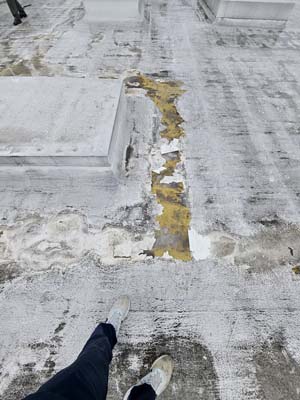
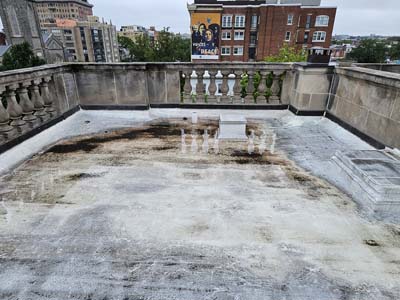
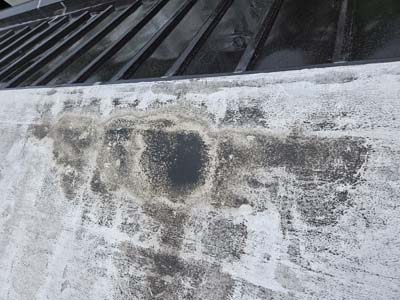
The existing roof at this Washington, DC embassy was a 18,675-square-foot, 39-year-old modified bitumen assembly installed over polyisocyanurate insulation board on a metal roof deck. The membrane had reached the end of its service life, with widespread alligatoring, cracking, and seam failures associated with a long leak history. A prior acrylic coating had failed and was overlaid with a second Henry aluminum coating, which had also failed; across approximately 20% of the roof the membrane was left with no functioning protective coating at all, so water reached the bare cap sheet directly rather than being shed. Six major low areas held standing water well past 48 hours because the original assembly had never been sloped correctly to the drains, and the drain assemblies themselves had deteriorated.
GoTech completely removed the existing membrane and insulation down to the metal deck. The roofing system was then rebuilt with R-20 polyisocyanurate insulation and a mechanically fastened Elevate UltraPly 60-mil TPO membrane. Tapered insulation and large water-shedding crickets were incorporated into the new insulation layer to correct all six major ponding slopes, so the drainage defect was designed out of the roof rather than carried forward into the new system.
All twelve roof drains were replaced with retrofit assemblies along with their drain pipe connections, the rooftop HVAC I-beam supports were flashed with Elevate 2-Part Liquid Flashing, and 21 pipe and vent penetrations received new pre-molded Elevate flashing. Work was staged so no opened roof section was left exposed overnight while the building was empty for renovation work. The completed roof received a 20-year Elevate Red Shield No Dollar Limit warranty, and the project was finished in 30 working days with zero recordable safety incidents.
Starting Point
Existing Conditions
The existing 39-year-old modified bitumen roof was exhibiting system-wide deterioration rather than a single isolated leak condition. Deficiencies included a failed acrylic coating overlaid by a later failed Henry aluminum coating, leaving roughly a fifth of the roof with no functioning protective coating, membrane alligatoring and cracking, seam failures, failed flashing at rooftop equipment, deteriorated drain assemblies, and persistent ponding across six major low areas created by inadequate slope. The conditions were documented by component so the extent of deterioration could be compared directly with the diagnostic testing that followed.
| Location | Observed condition | Extent | Leak history |
|---|---|---|---|
| Membrane field | Widespread alligatoring, cracking, and seam failures across the 39-year-old modified bitumen membrane, with extensive prior patching | 18,675 SF | Widespread reported leak history |
| Membrane coating loss | A prior acrylic coating had failed and was overlaid with a second Henry aluminum coating, which had also failed, leaving the modified bitumen cap sheet exposed to direct weathering | Approx. 20% of roof area | Active leakage through the uncoated membrane |
| Roof assembly | 39-year-old modified bitumen membrane, with a failed acrylic coating and a later failed Henry aluminum coating, over polyisocyanurate insulation board on a metal roof deck | 18,675 SF | Associated with active leak conditions |
| HVAC I-beam supports | Failed flashing at the rooftop HVAC I-beam supports | — | Reported at multiple curb locations |
| Drainage | Ponding held well past 48 hours away from the drains due to inadequate slope | 6 major ponding areas | — |
| Drain assemblies | Deteriorated drain bodies and drain pipe connections | 12 drains | Leakage observed at drain connections |
| Penetrations | Aged and failing pipe and vent penetration flashing | 21 penetrations | Reported at multiple penetrations |
How We Know
Investigation & Diagnostics
The investigation focused on identifying the construction of the existing roof assembly, documenting active failure points, measuring retained moisture within the existing system, and separating membrane failure from drainage-design problems. Using multiple methods reduced reliance on any single test and provided the basis for determining whether repair, restoration, recover, or full replacement was appropriate.
| Method | Instrument / reference | Finding |
|---|---|---|
| Core sampling | Full-depth cores cut and patched the same day | Confirmed the assembly in sequence: metal roof deck, polyisocyanurate insulation board, and a 39-year-old modified bitumen membrane |
| Capacitance moisture survey | Tramex non-destructive moisture meter | Non-destructive moisture readings were taken across the roof area to map retained moisture within the existing assembly and confirm the roof was not a candidate for recover or localized repair |
| Visual condition survey | Walk-over survey, NRCA inspection practice | Documented widespread alligatoring and cracking across the 39-year-old modified bitumen membrane, a failed acrylic coating overlaid by a later failed Henry aluminum coating leaving approximately 20% of the roof with no functioning protective coating, large seam failures, widespread prior patching, and multiple failed repairs associated with leak history |
| Drainage survey | Post-rainfall observation | Six major ponding areas identified for correction where inadequate slope held water away from the drains |
| Drain assessment | Inspection of drain bodies and pipe connections | Twelve drains and their pipe connections were deteriorated and required replacement with retrofit drain assemblies |
| Penetration survey | Component count and flashing condition review | 21 pipe and vent penetrations required new flashing, and the rooftop HVAC I-beam supports required liquid flashing as part of the new system |
Decision Record
Options Evaluated
Repair, restoration, recover, and complete replacement were evaluated against the documented membrane condition, the drainage deficiencies, remaining service life, occupant disruption, and availability of a long-term manufacturer warranty. The extent of seam failure, the loss of the membrane's protective coating over roughly 20% of the roof, and the six major ponding areas were primary factors, because installing a coating or recover system would have left the underlying slope defects and the deteriorated drains uncorrected and concealed.
| Option | Est. added service life | Tear-off | Disruption to occupants | Warranty available | Outcome |
|---|---|---|---|---|---|
| Continued repair | 1–3 years | None | Recurring above occupied tenant space | Workmanship only | Not selected |
| Coating restoration | Not viable | n/a | n/a | Not available at this seam condition | Not selected |
| Single-ply recover | 10–15 years | None, leaves slope defects in place | Moderate | Would not correct ponding or drains | Not selected |
| Full tear-off and TPO replacement | 20–25 years | Full, phased daily | Managed, no interior exposure | 20-year Red Shield NDL | Selected |
A membrane-only solution would have left the root causes in place: complete tear-off was the only approach that allowed the six major ponding slopes to be corrected and all twelve drains and drain pipe connections to be replaced as part of a warranted assembly.
What Was Installed
Specified System
The replacement roof was designed as a complete system rather than a membrane-only installation. After removal of the existing modified bitumen and insulation to the metal deck, the thermal assembly was rebuilt with R-20 polyisocyanurate insulation, and tapered insulation and crickets were incorporated to correct six major ponding areas. Twelve drain assemblies and their drain pipe connections were replaced with retrofit assemblies, and the rooftop HVAC I-beam supports and 21 pipe and vent penetrations were reflashed so the field membrane and roof interfaces functioned as one warranted assembly.
| Component | Product | Specification | Standard / reference |
|---|---|---|---|
| Insulation | Polyisocyanurate insulation board | R-20 over the existing deck | IECC §C402.2.1 minimum |
| Tapered system | Tapered polyisocyanurate and water-shedding crickets | 6 major ponding areas re-sloped | Positive drainage within 48 hours |
| Membrane | Elevate UltraPly 60-mil TPO | Mechanically fastened, heat-welded seams | Manufacturer written specification |
| Drain assemblies | Retrofit drain assemblies | 12 drains replaced and tied into the existing drain piping | Project-specific drainage correction |
| HVAC I-beams | Elevate 2-Part Liquid Flashing | Rooftop HVAC I-beam supports flashed in place | Manufacturer detail drawings |
| Penetrations | Pre-molded Elevate pipe covers | 21 pipe and vent penetrations flashed | Manufacturer detail drawings |
| Warranty | Elevate Red Shield NDL | 20-year no dollar limit warranty issued | Elevate warranty requirements |
How It Was Delivered
Execution
The project was completed over 30 working days during December 2023 and January 2024.-
Scope development
GoTech documented the membrane failures, existing roof construction, drainage deficiencies, and leak-related conditions so the replacement scope, slope correction, and drain reconstruction could be defined before work began.
-
18,675-SF tear-off to the metal deck
The existing modified bitumen membrane and polyisocyanurate insulation were removed down to the metal roof deck. Tear-off was phased daily so each opened area was dried in before the end of the shift and the tenant spaces below were never left exposed.
-
Slope correction and drain reconstruction
R-20 polyisocyanurate insulation was installed over the bare deck, and tapered insulation with large water-shedding crickets was built into six major low areas to establish positive drainage. All twelve roof drains and their drain pipe connections were rebuilt and integrated into the new assembly.
-
TPO installation, curbs, and penetrations
A mechanically fastened Elevate UltraPly 60-mil TPO membrane was installed over the new insulation. The rooftop HVAC I-beam supports were flashed with Elevate 2-Part Liquid Flashing and 21 pipe and vent penetrations received new pre-molded Elevate flashing so every transition point was reconstructed as part of the warranted system.
-
Drainage verification and warranty closeout
The completed drainage corrections were checked after installation to confirm the corrected slopes carried water to the rebuilt drains, and the roof was closed out under a 20-year Elevate Red Shield No Dollar Limit warranty.
Measured Outcome
Results
The completed work replaced a roof system that had reached the end of its useful service life and corrected the slope and drainage defects that had caused water to stand on it. The result is a long-term warranted TPO assembly that drains to twelve new retrofit drain assemblies, installed while the building was empty for renovation work.
Verification & Documentation
The project record documents the existing roof construction, the basis for the replacement recommendation, completed replacement work, drainage corrections, and manufacturer warranty closeout.
- Core sample — documented the metal roof deck, polyisocyanurate insulation board, and the 39-year-old modified bitumen membrane above it
- Tramex moisture survey — non-destructive moisture meter readings were recorded across the roof area to document retained moisture in the existing assembly and support the tear-off recommendation
- Condition record — photographs documented severe alligatoring and cracking, a failed acrylic coating overlaid by a later failed Henry aluminum coating leaving approximately 20% of the roof with no functioning protective coating, failed seams, extensive prior patching, and persistent ponding
- Tear-off — existing roofing removed completely to the metal deck before the new R-20 PolyISO and Elevate UltraPly TPO system was installed
- Drainage correction — tapered PolyISO and large water-shedding crickets corrected six major ponding slopes, and all twelve drains and drain pipe connections were replaced with retrofit assemblies
- Rooftop details — rooftop HVAC I-beam supports flashed with Elevate 2-Part Liquid Flashing and 21 pipe and vent penetrations flashed with new pre-molded Elevate covers
- Manufacturer warranty — 20-year Elevate Red Shield No Dollar Limit warranty issued for the completed roof
- Safety record — 0 recordable incidents during the 21-working-day project
The project demonstrates why a commercial roof replacement should address the causes of failure rather than the membrane alone: correcting the six ponding slopes and replacing every drain ensured the new assembly drained properly instead of repeating the defect that shortened the life of the previous roof.
Photographic Record
Evidence
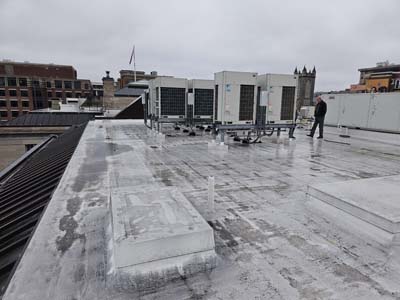
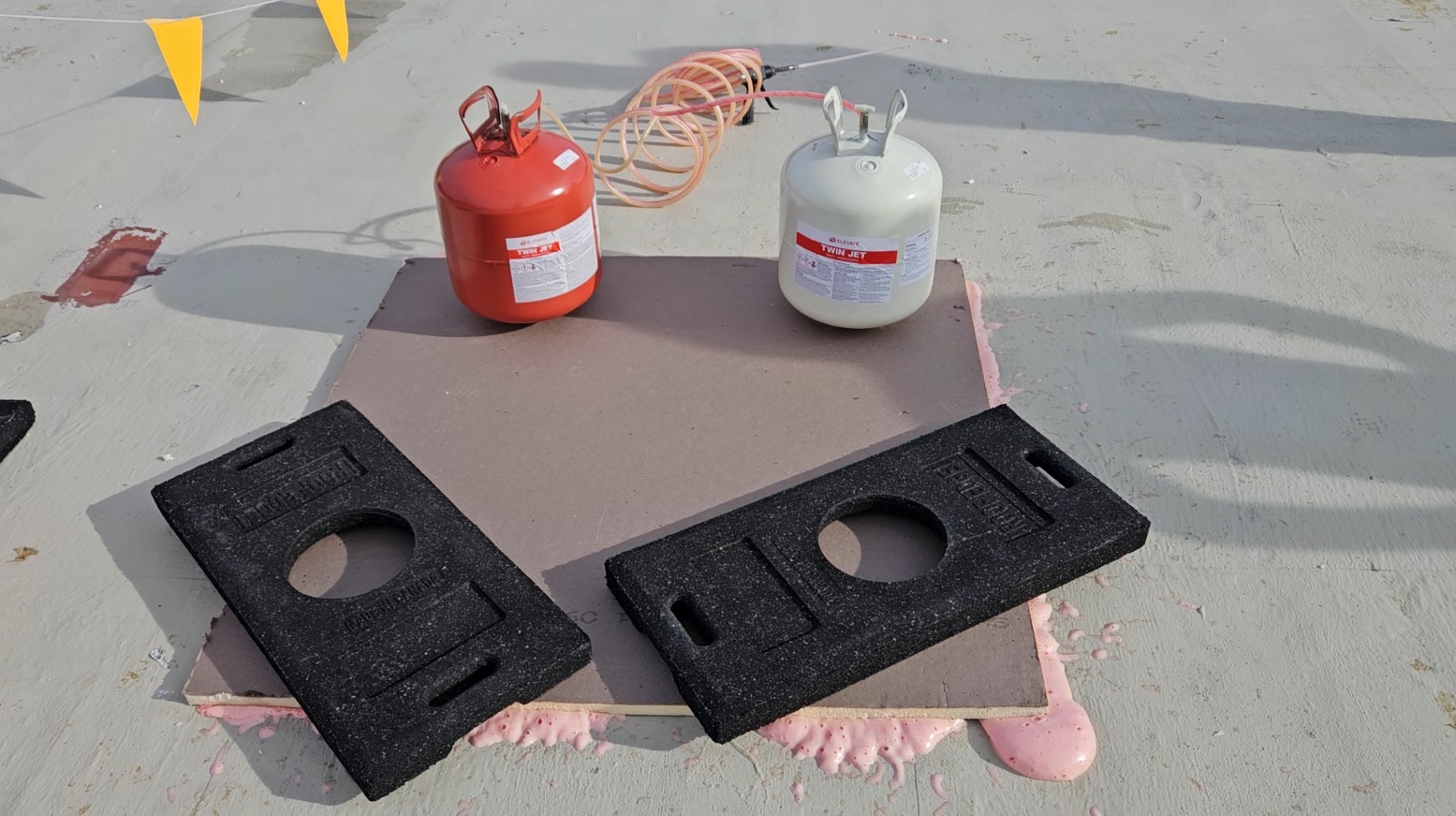
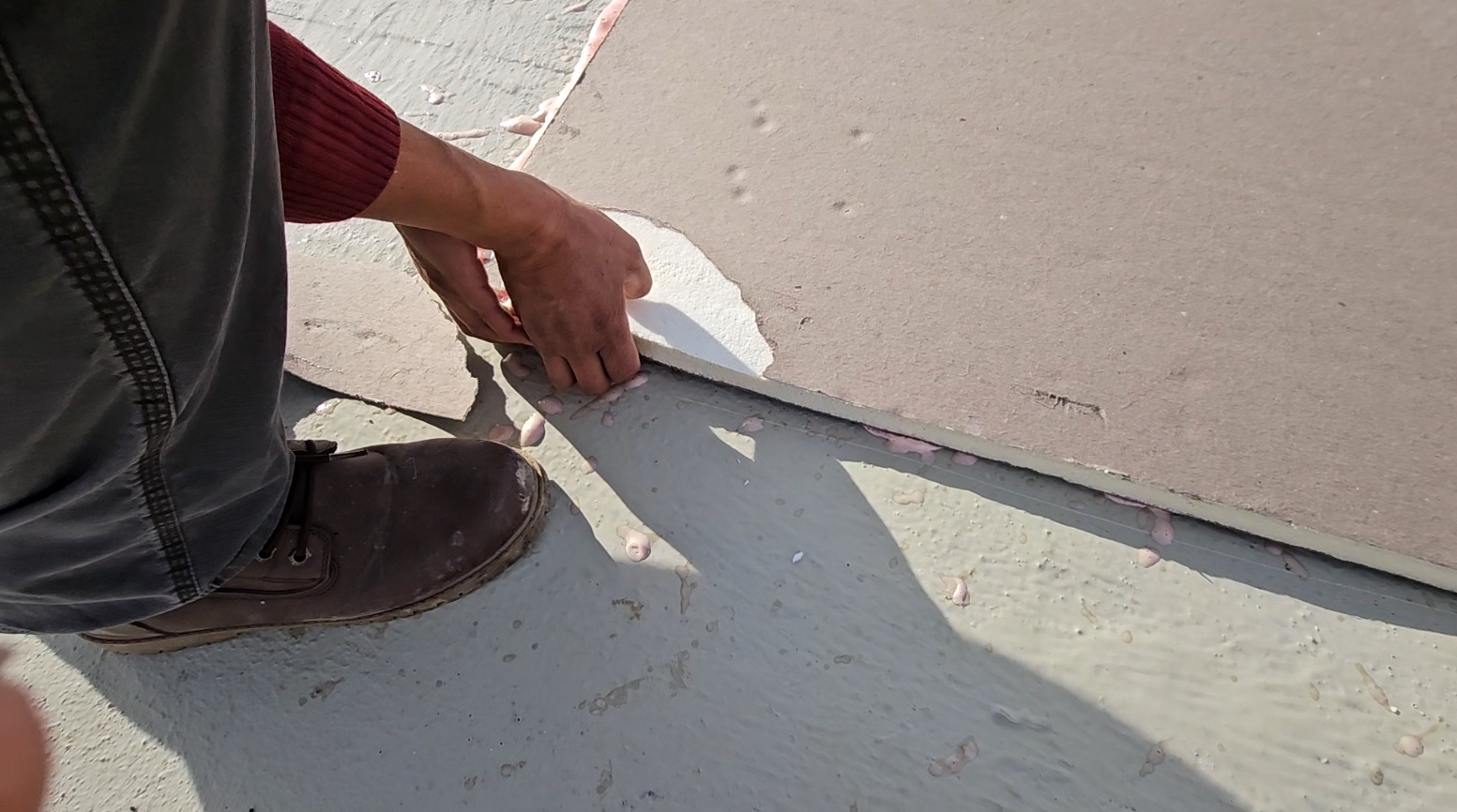
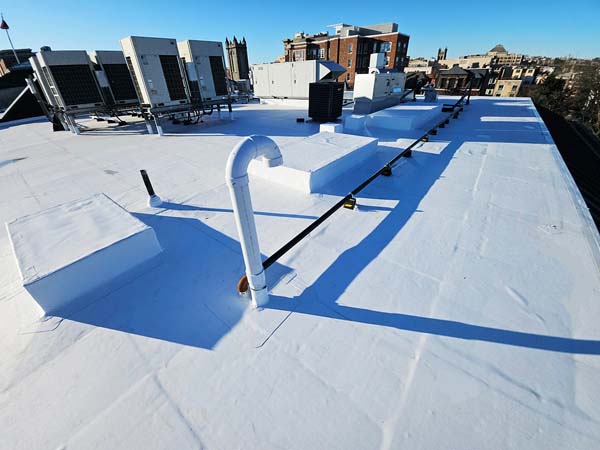
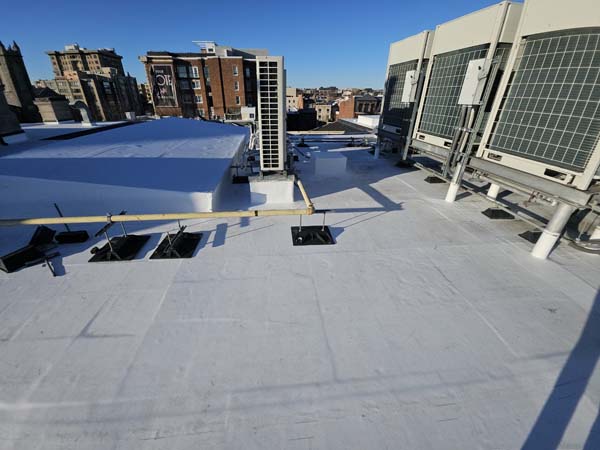
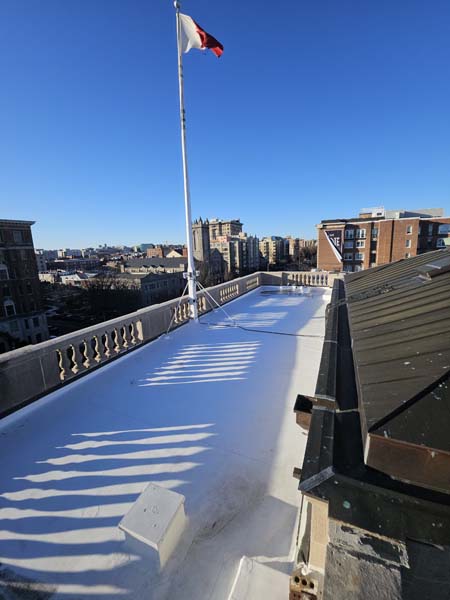
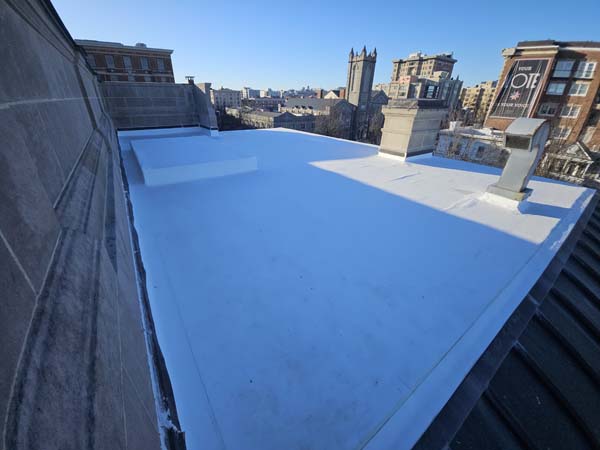
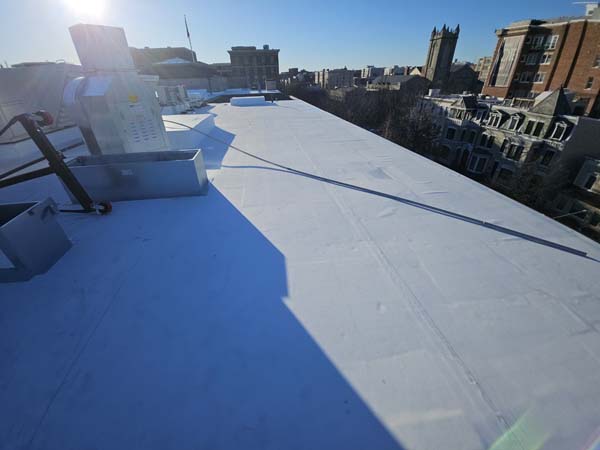
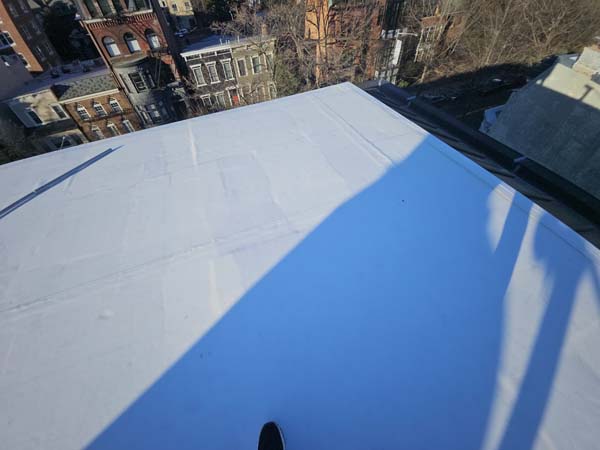
Original project photographs document the failing membrane and the standing water it held, the insulation adhesion testing carried out before installation, and the completed Elevate UltraPly TPO roof across the embassy roof areas.
Who Did the Work
Project Team & Credentials
Site Supervision
All field crew members assigned to the project had completed OSHA 30-Hour Construction Safety training, with a designated Fall Protection Competent Person on site for the duration of the work.
Manufacturer Certification
GoTech Roofing held current Elevate manufacturer-authorized applicator status at the time of the work, a requirement for installation of the warranted Elevate roofing system.
Inspection & Reporting
GoTech Roofing commercial roof inspection staff documented the pre-project roof conditions, Roof 1 core sample, Tramex moisture meter survey of Roofs 1 and 2, membrane failures, drainage observations, and roof-by-roof repair or replacement recommendations. Elevate warranty closeout was completed for the two new TPO replacement roofs.
Common Questions
Commercial Roof Replacement & Drainage FAQ
These are the questions commercial property owners and facility managers most often ask when a flat roof is ponding, leaking, or nearing the end of its service life. Each answer explains the general principle so you can evaluate your own building's roof.
Does ponding water on a flat roof mean the roof has to be replaced?
Not always. Ponding is most often a slope and drainage design defect rather than a membrane failure, so standing water alone does not condemn a roof. Industry practice treats water remaining on a roof more than 48 hours after rainfall as ponding, and it accelerates membrane aging, adds structural load, and voids many manufacturer warranties. The correct test is whether the membrane itself is still serviceable and whether the assembly below it is dry. If the membrane is sound, ponding can often be corrected on its own with tapered insulation and crickets. If the membrane has failed, the ponding should be designed out during a full replacement so the new roof does not repeat the defect.
How do you know whether a commercial roof needs to be replaced or just repaired?
The decision should be based on documented condition, not age. A qualified assessment combines a physical core sample to identify the deck and existing assembly, a moisture survey to determine how much water is trapped in the assembly, and a post-rainfall drainage assessment to separate membrane failure from slope defects. Isolated damage on an otherwise sound roof is a repair. Widespread seam failure, a membrane that has lost its protective surface, saturated insulation, or a corroded deck point to replacement, because those conditions will continue to progress underneath any patch or coating applied over them.
What does a roof core sample show?
A core sample is a small full-depth cut through the roof that reveals the deck material, the type and thickness of insulation, whether that insulation is wet, and how many roofing systems have already been installed. That information determines whether a new roof can legally and practically be installed over the existing one, what fastener lengths and attachment method the new system requires, and what R-value already exists. The core is patched the same day it is taken.
What is a Tramex moisture meter survey and why is it done before a roof replacement?
A Tramex moisture meter survey is a non-destructive scan that measures the electrical impedance of a roof assembly to locate moisture trapped in the insulation and substrate. It is performed before replacement because wet insulation cannot be roofed over: a recover installed above saturated material will trap the moisture, degrade the insulation's R-value, corrode a metal deck, and void manufacturer warranty coverage. The survey maps which areas are wet, which determines whether the roof is a candidate for recover or requires a full tear-off.
Can a new commercial roof be installed over an existing one?
Sometimes, but only under specific conditions. Building codes generally limit a roof to two total roofing systems, and a recover is only appropriate when the existing assembly is dry, structurally sound, and adequately sloped. A recover also leaves the existing slope in place, so it cannot resolve ponding. When a second roof is already present, when moisture testing shows a saturated assembly, or when the deck below has corroded, a full tear-off to the deck is the only compliant option.
How is ponding water fixed without replacing the entire roof?
Ponding is corrected by rebuilding the slope rather than the membrane. Tapered polyisocyanurate insulation is added in the low areas and feathered out into the roof field, and water-shedding crickets are constructed to divert runoff toward drains, scuppers, or the gutter edge. The new work is then tied into the existing membrane. Deteriorated drain bodies and drain pipe connections are typically rebuilt at the same time, since restoring slope accomplishes little if the outlets the water is directed to are themselves blocked or leaking.
What does a commercial TPO roof replacement assembly include?
A complete TPO replacement is more than a new membrane. It includes tear-off to the deck, repair or replacement of any deteriorated decking, new insulation to the specified R-value, slope correction where drainage is inadequate, rebuilt drains, reconstructed HVAC and vent curbs, new flashing at every penetration, and new perimeter edge metal. The membrane is then attached mechanically or fully adhered depending on the deck type and wind-uplift requirements. A proposal that prices only the field membrane is not a complete replacement.
How long does a commercial TPO roof replacement take on an occupied building?
Schedule depends on roof area, tear-off volume, and how much rooftop equipment and drainage work is involved, but a properly staged replacement can proceed without closing the building. The roof is opened in sections small enough to be torn off, insulated, and dried in within the same shift, so no area over occupied space is left exposed overnight. Staging, material hoisting, and hot work are coordinated around business hours, and tenants are notified in advance of work directly above their space.
What is an Elevate Red Shield NDL warranty?
NDL means No Dollar Limit. An Elevate Red Shield NDL warranty provides manufacturer-backed coverage for covered conditions during the warranty term without a repair-cost cap tied to the original contract value, subject to the warranty terms and exclusions. It requires the manufacturer to inspect and approve the completed roof, and it is only available through manufacturer-authorized applicators, which is why the installing contractor's Elevate licensing status matters on a warranted commercial roof.
Keep Looking